Ecommerce Accounting & Inventory Management Software for Meesho, Flipkart & Myntra Sellers
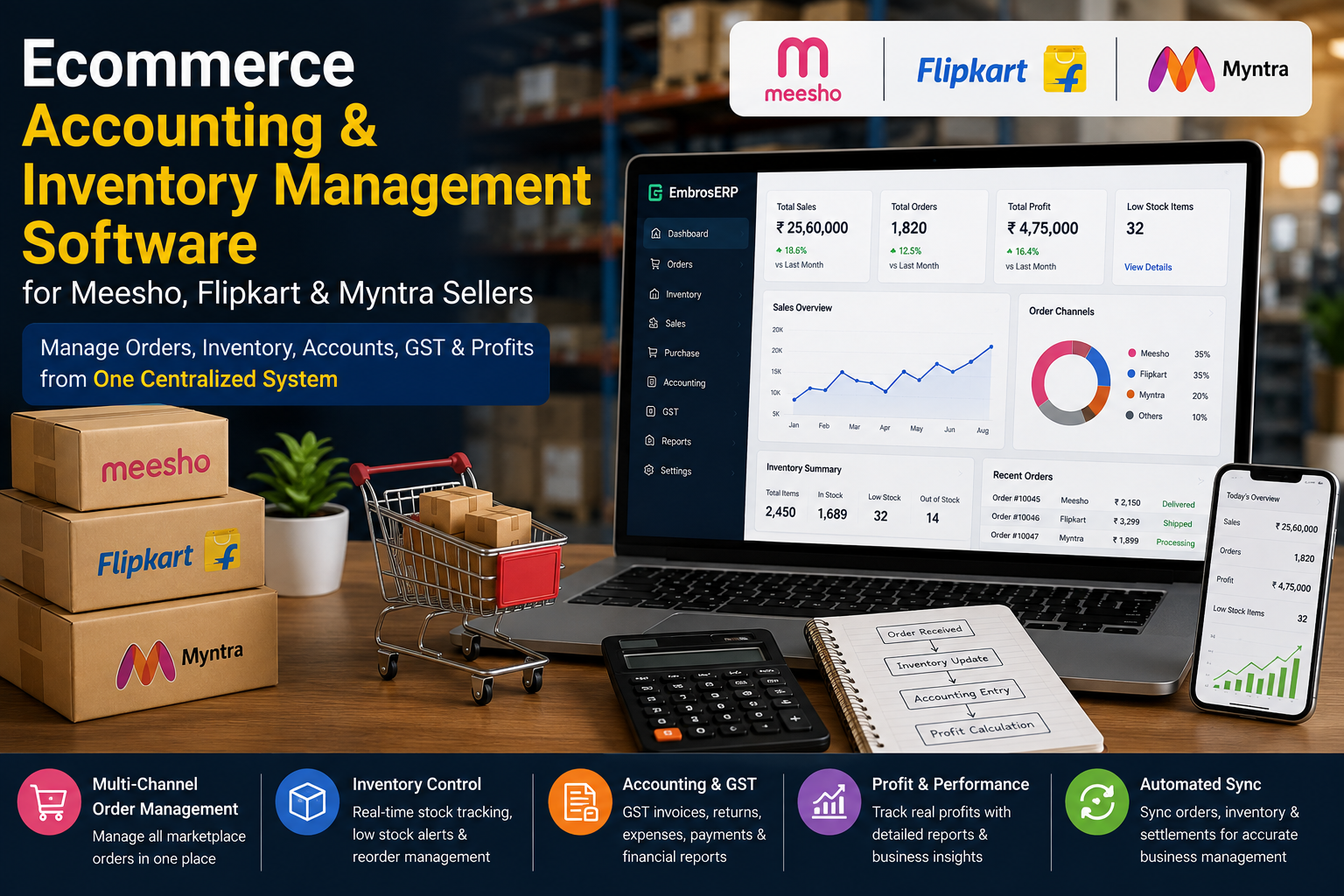
Ecommerce Accounting & Inventory Management Software for Meesho, Flipkart & Myntra Sellers
Selling products online has become easier, but managing an ecommerce business can become complicated when orders, inventory, returns, payments, expenses and accounting are handled separately.
A seller may receive orders through multiple marketplaces such as Meesho, Flipkart, Myntra and other online channels. As order volume increases, keeping track of stock, sales, returns, marketplace charges, customer payments and business expenses becomes increasingly important.
This is where ecommerce accounting software and inventory management software for ecommerce sellers can help.
Instead of maintaining separate spreadsheets for sales, stock and accounts, businesses can organize their important information through a centralized business management system.
Why Ecommerce Sellers Need Accounting and Inventory Management Together
For an online seller, accounting and inventory are closely connected.
When a product is sold, stock changes.
When an order is returned, inventory may change again.
When a marketplace settles a payment, the amount received may be different from the original order value because of marketplace charges, returns, shipping-related costs, taxes or other adjustments.
This creates a workflow such as:
Order → Stock Movement → Sale → Return → Settlement → Accounting → Profit
Managing each step separately can make business reporting difficult.
An integrated approach can help businesses maintain a clearer picture of their operations.
What Is Ecommerce Accounting Software?
Ecommerce accounting software is a business accounting system designed to help online sellers organize their financial transactions.
Depending on the system and business requirements, it can be used to manage:
- Sales
- Purchases
- Expenses
- Customer accounts
- Supplier accounts
- Payments
- Invoices
- GST-related records
- Inventory transactions
- Business reports
- Profit and loss information
For marketplace sellers, accounting becomes even more important because sales and actual marketplace settlements may not always happen at the same time.
What Is Ecommerce Inventory Management Software?
Ecommerce inventory management software helps sellers monitor products and stock across their business operations.
A seller may have hundreds or thousands of SKUs.
Without organized inventory management, it can become difficult to answer simple questions such as:
- How much stock is available?
- Which products are selling quickly?
- Which products are low in stock?
- How many units were sold?
- How many products were returned?
- How much stock is currently available?
- Which products need replenishment?
A centralized inventory system can make these records easier to organize and analyze.
Meesho Sellers and Inventory Management
Meesho sellers can deal with a large number of product orders, cancellations and returns depending on their business category and sales volume.
When order volume increases, manually maintaining product stock in spreadsheets can become difficult.
An ecommerce inventory management system can help sellers organize:
- Product information
- SKU records
- Stock quantities
- Sales transactions
- Purchase records
- Returns
- Inventory adjustments
- Reorder information
Sellers should always configure their inventory workflow according to the actual marketplace reports and their business process.
Flipkart Sellers and Accounting Management
Flipkart sellers also need to maintain organized records of online sales, purchases, expenses and settlements.
Accounting software can help businesses maintain structured records instead of manually combining information from different spreadsheets.
For businesses selling across multiple channels, keeping marketplace sales and overall business accounting organized becomes especially important.
A centralized accounting workflow can help management understand:
- Total sales
- Purchase costs
- Expenses
- Customer payments
- Supplier payments
- Returns
- Inventory value
- Overall profitability
Myntra Sellers and Inventory Management
Fashion and apparel businesses can have particularly complex inventory because products may have different sizes, colors, styles and SKUs.
For example, a single shirt design could have:
- Multiple sizes
- Multiple colors
- Multiple SKUs
- Different stock quantities
This makes accurate inventory management important.
An organized inventory system can help businesses maintain product-level stock information and monitor stock movement as orders and returns occur.
Why Inventory Accuracy Matters for Marketplace Sellers
Inventory accuracy directly affects ecommerce operations.
If the actual stock is different from the recorded stock, businesses may face operational problems.
For example:
Actual Stock = 10
System Stock = 15
A seller may accept orders for products that are not actually available.
On the other hand:
Actual Stock = 15
System Stock = 10
The business may miss potential sales because the system shows insufficient inventory.
Accurate stock records can therefore help sellers make better purchasing and sales decisions.
Ecommerce Accounting Software vs Excel
Excel is widely used by small businesses because it is flexible and easy to start with.
However, ecommerce businesses can generate a large amount of transactional data.
A typical seller may have information related to:
- Orders
- SKUs
- Sales
- Purchases
- Returns
- Expenses
- Payments
- Inventory
- Marketplace settlements
Managing all of this manually across multiple Excel files can become difficult as the business grows.
| Excel-Based Management | Ecommerce Business Software |
|---|---|
| Manual data entry | Structured data management |
| Multiple spreadsheets | Centralized records |
| Manual calculations | Automated calculations may be available |
| Difficult to maintain large datasets | Designed for larger transaction volumes |
| Separate inventory and accounting files | Connected business workflows |
| Reports require manual preparation | Business reports can be generated from stored data |
Excel can still be useful for analysis, but businesses with growing transaction volumes may benefit from dedicated business management software.
The Ecommerce Seller Workflow
A well-organized ecommerce business can follow a connected workflow:
Step 1: Purchase
The business purchases products or raw materials from suppliers.
↓
Step 2: Inventory
Purchased products are recorded and added to available stock.
↓
Step 3: Marketplace Sale
Products are sold through online marketplaces.
↓
Step 4: Stock Movement
The sold quantity is deducted from available inventory.
↓
Step 5: Return or Cancellation
If an order is cancelled or returned, the inventory status is updated according to the actual business process.
↓
Step 6: Marketplace Settlement
The seller receives the marketplace settlement after applicable deductions and adjustments.
↓
Step 7: Accounting
Sales, purchases, expenses, payments and other financial transactions are organized in the accounting system.
↓
Step 8: Reports
Management can review sales, inventory, expenses and profitability.
This connected workflow is one of the main reasons ecommerce businesses consider ERP and integrated accounting systems as they grow.
What Should Ecommerce Accounting Software Include?
When choosing accounting software for an ecommerce business, sellers should evaluate several features.
Sales Management
The software should allow businesses to maintain organized sales records and invoices.
Purchase Management
Businesses should be able to record purchases and supplier transactions.
Inventory Management
Stock quantities and inventory movements should be easy to monitor.
Expense Management
Businesses should be able to record operational expenses and understand their impact on profitability.
Payment Tracking
Customer and supplier payments should be organized and easy to review.
GST-Related Records
Indian businesses should evaluate whether the software supports the GST workflows and reporting requirements applicable to their business.
Business Reports
Reports should help management understand sales, purchases, expenses, inventory and overall business performance.
User Management
Growing businesses may have multiple employees handling sales, accounts, inventory and operations.
Role-based access can help businesses control access to different areas of the system.
How Ecommerce Sellers Can Track Real Profit
Revenue alone does not tell the complete story.
Suppose an online seller receives a sale worth ₹1,000.
The seller may also have expenses related to:
- Product cost
- Packaging
- Shipping
- Marketplace charges
- Advertising
- Returns
- Other business expenses
Therefore:
Revenue ≠ Profit
A useful accounting system should help businesses organize the different financial components required to understand their actual business performance.
Sellers should also reconcile marketplace settlements with their own accounting records rather than assuming that the gross order value is the final amount received.
Marketplace Returns and Inventory
Returns are an important part of ecommerce operations.
When an order is returned, the business may need to determine:
- Whether the product came back into stock
- Whether the product is damaged
- Whether it can be resold
- Whether inventory needs adjustment
- Whether the financial transaction needs correction
Without proper records, returned products can create differences between physical inventory and system inventory.
A connected inventory and accounting workflow can make these adjustments easier to track.
Why Multi-Marketplace Sellers Need Centralized Management
Many ecommerce businesses eventually sell through multiple channels.
For example:
Meesho + Flipkart + Myntra + Website + Other Channels
Managing every channel separately can create duplicated work.
A centralized business management system can provide a single place for the business to organize its overall operations.
The objective is not simply to collect marketplace data.
The objective is to create a reliable business workflow covering:
Sales + Inventory + Purchases + Accounting + Expenses + Reports
Ecommerce ERP vs Accounting Software
Accounting software primarily focuses on financial transactions.
ERP software can connect accounting with other business operations.
For an ecommerce business, an ERP-style workflow can include:
- Inventory
- Purchases
- Sales
- Accounting
- Billing
- Expenses
- Reports
- Business management
This can be particularly useful for growing sellers who have moved beyond simple bookkeeping and need greater control over their operations.
How EmbrosERP Can Help Ecommerce Businesses
EmbrosERP is designed as an integrated business management and ERP platform.
Businesses can use an ERP approach to organize important operational processes such as:
- Sales
- Purchases
- Inventory
- Accounting
- Billing
- Business reports
For an ecommerce seller, the goal is to maintain a centralized business workflow instead of managing every process through disconnected spreadsheets.
If your business sells through marketplaces such as Meesho, Flipkart or Myntra, your accounting and inventory workflow should be designed around the reports, settlement process and operational requirements of your actual sales channels.
How to Choose the Right Ecommerce Accounting Software
Before choosing software, ask these questions:
Can it manage your inventory?
Your system should be able to support your SKU structure and stock workflow.
Can it manage accounting?
It should support the accounting processes required by your business.
Can it track sales and purchases?
Sales and purchases should be organized and easy to review.
Can it handle returns?
Returns should be reflected correctly in your business records.
Can it generate useful reports?
Reports should help you understand your business performance.
Can your business scale with it?
The software should be suitable for your current requirements while allowing room for future growth.
Final Thoughts
Running an ecommerce business involves much more than receiving orders.
Sellers need to manage inventory, purchases, sales, returns, payments, expenses, accounting and business reporting.
For sellers operating across platforms such as Meesho, Flipkart and Myntra, maintaining organized records becomes increasingly important as order volume grows.
The right ecommerce accounting software combined with effective inventory management software can help businesses create a more organized workflow.
Instead of managing sales, stock and accounts separately, businesses can move toward a centralized system where important operational information is easier to manage and review.
EmbrosERP provides an integrated ERP approach for businesses looking to bring accounting, inventory, sales, purchases and business management into a centralized platform.
The right solution should always be selected according to your business size, sales channels, inventory structure, accounting requirements and future growth plans.
Want to streamline your factory?
Get a free consultation and customized demo of Embros ERP built for your exact production flow.
Request Demo Now